

If you prefer to listen to this essay…
Welcome to the dystopia. It comes with a gift bag. 💁♀️
Specifically: a jar of OpenAI-branded honey, and a canvas tote to carry it home in.
Somewhere between a beekeeping workshop and a lunch-and-learn on ChatGPT Work, a group of influencers walked away with both, at a luxury resort in the Hudson Valley, while the company that made them is finalizing a $500 billion data center deal in Ohio. I didn't have to reach for that metaphor. It arrived pre-packaged, branded, and gift-wrapped.

It’s all about timing?
Don’t miss that type of wake-up call ⏰
What actually happened
OpenAI hosted its first influencer brand trip over the weekend — a two-day retreat at Wildflower Farms called Summer Club, often referred to as Summer Camp. Rooms there typically run around $2,000 a night. A handful of creators were flown in for farm-to-table dinners, wellness activities, a painting workshop, and hands-on sessions on ChatGPT Work, OpenAI's new workplace tool.
The videos were soft, sunlit, aesthetic. The comments were not.
@graceforpersonalityhires I genuinely can’t believe I was on @ChatGPT ‘s first ever brand trip. I am so honored!! Hang with me and I’ll tell you what I think the re... See more
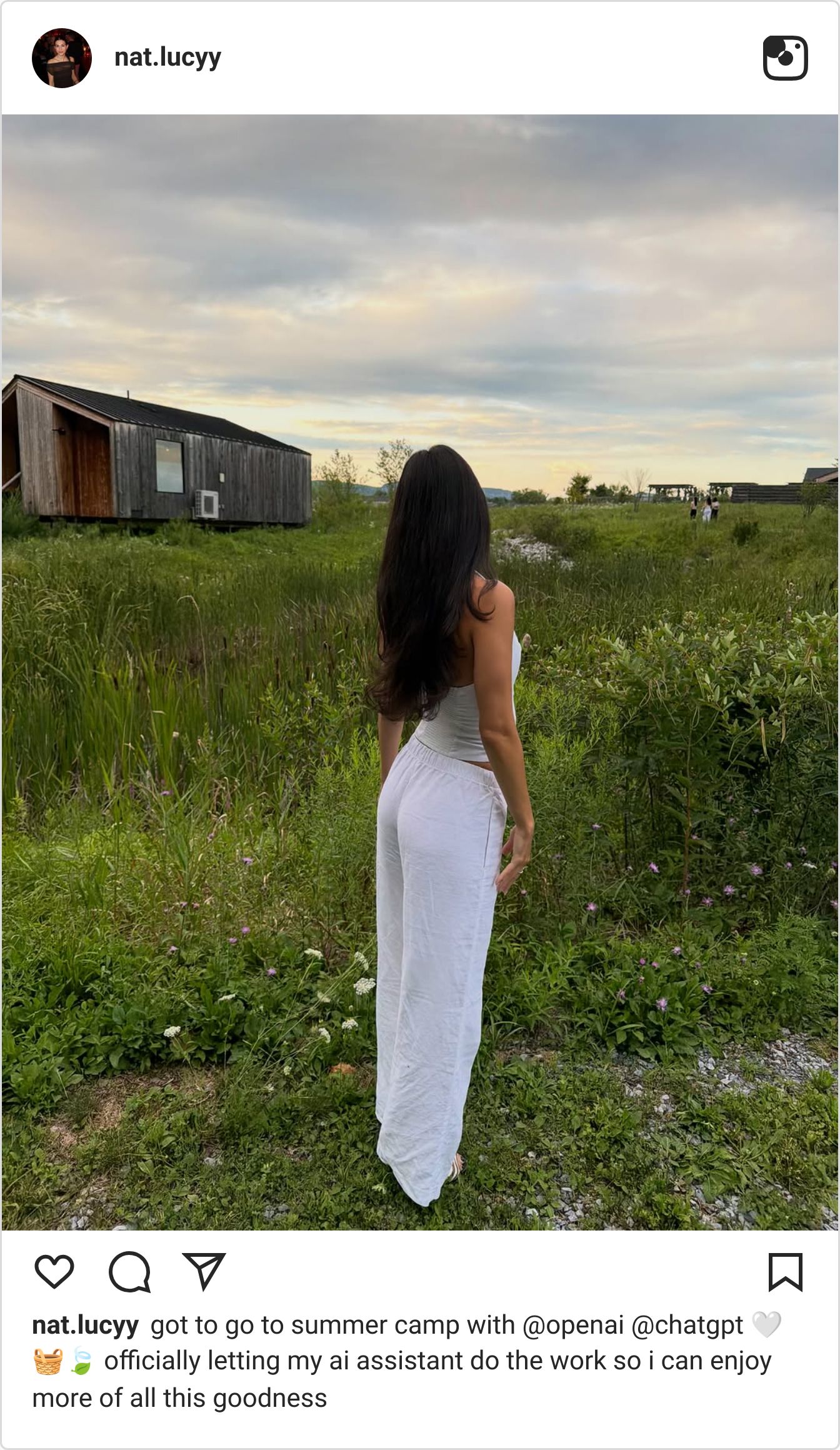
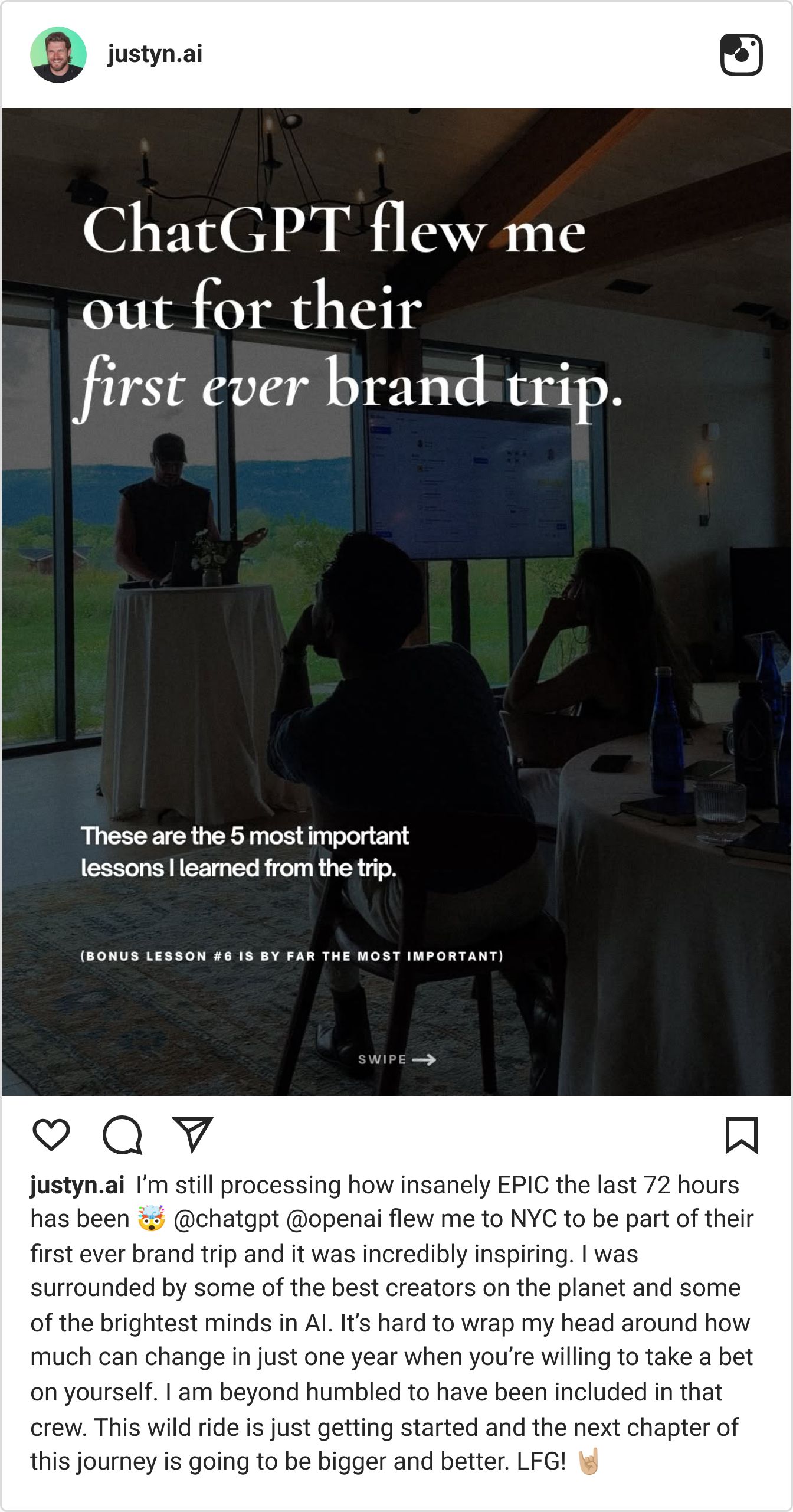
@meglovesdata Can't wait to show you guys more from my brand trip with @OpenAI 👀. PSA: Get off IG start posting on LinkedIn I'm begging you 🙏Comment CHA... See more
One creator was asked, more or less directly, whether she could reconcile a luxury suite with the environmental cost of the data centers running the tool she was there to promote. Another got a sarcastic invitation to film a "get ready with me" at a data center next time. A third quietly deleted her post while leaving the rest of her feed untouched. That's not an accident. That's the tell.
The word that kept showing up across platforms was "greenwashing”; commenters used it specifically, not just generally annoyed. Journalist Taylor Lorenz put it more bluntly on X: creators attending the event were getting "cancelled3." One Redditor summed up the whole weekend in a single line: This is the proper context to use the word dystopian. He wasn't wrong. He just said it first.
OpenAI's spokesperson called it education-led: a chance for creators to get hands-on with the tools so they could demonstrate them to their audiences. One influencer, blindsided by the response, wrote on LinkedIn that she never considered the trip would be controversial. She thought people would want the behind-the-scenes tips.
That gap between what OpenAI thought it was selling and what the internet decided it was buying is the whole story.

Let’s sit down in front of the campfire for some ghastly stories instead 🏕️
Nobody asked the reporters
Say what you want about WeWork's excesses, and there's plenty to say, but reporters were in the room. When Adam Neumann held court, journalists were credentialed, badged, and close enough to ask an uncomfortable question on the record. The mythology got built in public, which meant it also got punctured in public. That's how we ended up with the documentaries, the podcasts, the miniseries. The excess was witnessed by people whose job was to write it down accurately, not just prettily.
That's not what happened at Wildflower Farms. This wasn't covered by journalists. It was covered by the attendees, filming their own experience for their own feeds, with editorial control that began and ended with themselves. Nobody in the room was obligated to print the awkward answer if they got one.
And the opacity didn't end when the weekend did. Business Insider reached out afterward and got nothing: none of the creators contacted responded to requests for comment, and OpenAI wouldn't say whether attendees were paid, whether travel and lodging were covered, or whether posting was ever expected as part of the deal. Those are the most basic disclosure questions a brand trip generates, and the company that hosted it chose silence on all three, after the fact, once the cameras were off and the only people asking were people it didn't need to keep happy.

🍕 floating on Raquette Lake in Upstate New York 🍊
An influencer trip isn't journalism, and creators aren't failing at a job they never signed up for. But when a company's entire creator strategy is built on handing people a feeling instead of an argument, on curated proximity instead of scrutiny, the absence of anyone empowered to ask wait, why though isn't incidental. It's the design.
You don't invite people who ask hard questions to an event built to generate soft content. That's not an oversight; it's the brief.
Control who's in the room, and you control what gets said about the room. WeWork lost that control when it went public and had to open its books. OpenAI hasn't had to yet. A weekend filtered entirely through people financially incentivized to have a good time, followed by silence when the actual disclosure questions came in, is what "controlling the narrative" looks like when you've learned from the last guy's mistakes.

Summer Camp 2016 #priorities
We've seen this movie
None of this is new. Shein flew influencers to China1 to tour factories while facing ongoing scrutiny over labor practices. Every AI lab is doing some version of this. Anthropic hosted an influencer dinner for Claude. Microsoft Copilot took creators to the Super Bowl. Neither drew blood the way this one has.
Why did this one land differently? Timing. OpenAI is mid-negotiation on that Ohio data center and sitting on a $200 million Department of Defense contract. Both showed up, unprompted, in the comments. People aren't just annoyed about a nice hotel room anymore. They're doing the math on what that hotel room costs somewhere else, in water, in electricity, in a grid that's already straining.
Sam Altman himself has admitted the temperature has changed. At BlackRock's US Infrastructure Summit, he said AI isn't very popular right now, that data centers are getting blamed for price hikes, that companies doing layoffs blame AI whether or not AI is actually the cause2. That's not a critic or journalist talking. That's the CEO, reading the room out loud, and then sending influencers to a spa anyway.

You didn’t win the lipsync contest performing Sia’s Chandelier? How weird.
The WeWork of it all
Dror Poleg made the structural case4: WeWork bought long leases and sold short ones, and the gap between what it spent and what it made never closed before the market stopped believing the story. OpenAI's version of that gap is R&D, billions spent building models that go out of date almost as fast as they ship, in a field where users can switch to a competitor with less friction than breaking a lease. Poleg's read is that OpenAI is probably worse off than WeWork, with one narrow exception: if the technology produces a genuine breakthrough, the payoff could be bigger than real estate ever was. That's a big if.
Here's my case: Altman and Neumann have both described themselves in something close to godlike terms, men not running companies so much as ushering in a new era, even as the underlying business turns out to be expensive and fragile. That self-mythologizing is what let WeWork get away with "elevating the world's consciousness" as an actual mission statement while it was subletting desks.
Summer Camp, the actual name OpenAI used, unprompted, for its own event, is Neumann's playbook awaiting its own documentary and Apple TV series.

Summer Camp 2017
The part few are saying out loud
The backlash wasn't evenly distributed.

hello ladies
The men who attended got comments like "hell yeah, bro." The women got interrogated about their morals, their awareness, their soul, whether they'd sold it for a nice hotel room. Every attendee deserves scrutiny, full stop. Nobody gets a pass for attaching their name to this. But the shape of that scrutiny broke down along lines that are hard to ignore.
Is that sharper built-in skepticism? Structural exclusion from the rooms where these tools get normalized: the boardrooms, the term sheets, the "move fast" cultures that have historically had one demographic doing most of the moving? The pattern is there. And the pattern has a longer history than one brand trip.
Female-voiced assistants by default, because a woman's voice reads as more trustworthy, more helpful, less threatening. Campaigns built around getting women "into" AI, framed as feminist milestones rather than product pushes. Reese Witherspoon spent a week fronting exactly this, a post declaring that women's jobs are three times more likely to be automated, that women use AI 25% less than men, wrapped in the language of catching up before it's too late. The backlash was immediate: people accused her of running a paid ad disguised as advocacy, and she had to deny publicly that she was being compensated.
Kylie Jenner. Smart glasses. Same playbook.

loser behavior 🕶️
Women recruited, again and again, as the warm welcome mat for a technology whose actual costs – displaced labor, warped incentives, extracted water and power – land on everyone regardless of who did the inviting.
Put a woman's face and voice on the thing you're worried people won't trust, and you've outsourced the trust-building without changing anything about what's being built. It's a pattern with a paper trail. Marketers should be honest enough to name it when we see it happening in real time, especially when we're the ones capable of building the campaign ourselves.
What this actually is
Strip away the honey and the beekeeping and what's left is a familiar shape: a company running low on organic goodwill, buying some at retail price.
What's new is the mismatch in scale. This isn't a shoe company. This is an industry currently reordering the electrical grid, the labor market, and the information ecosystem, sending creators out to reassure the public that it's all fine, actually, look how nice the s'mores are.
Enshittification with a wellness itinerary. The Temu of thought leadership.
There's a term that's entered clinical and media vocabulary this past year: "AI psychosis.” An informal, non-diagnostic label doctors and reporters use for delusion-like thinking that can emerge in individual heavy users of chatbots, under specific and fairly rare conditions. I want to be precise about it, because it's not mine to apply to anyone in this story, and I'm not diagnosing the influencers, the commenters, or anyone else with a condition they haven't claimed. But the phrase is useful as a mirror held up to the industry's own language, not any one person's mind.
An industry whose CEO compares his product to a "wealth fountain" and a "new era for humanity," whose marketing strategy is to manufacture an oasis and film it as proof of goodness, is fluent in exactly the kind of reality-distortion the clinical term describes at an individual level — just scaled up to a boardroom, a keynote, a name like "Summer Camp." The industry doesn't have psychosis. It has a marketing budget doing the same job: making the story feel truer than the balance sheet.
And the thing about a genuinely great product: it doesn't need this. It doesn't need a luxury retreat to manufacture affection. It earns affection by working. The fact that OpenAI reached for Summer Camp tells you something about how confident they actually are in what they're selling.

Summer Camp 2015
Where I land
I don't think the influencers who went are uniquely bad people. Most of us would take the free weekend. That's not the indictment.
The indictment is what happens after: whether you can hold the trip and the truth about what it's in service of in the same hand, or whether you pretend they're unrelated. Several of these creators, faced with pointed questions, responded with confusion, as if the backlash were the surprising part, rather than a predictable consequence of attaching your name to an industry currently being blamed, by its own CEO, for rising electricity bills and disappearing jobs.
Shame isn't the answer. Threats aren't the answer. But neither is faux-bewilderment. You don't get to take the trip, post the trip, and act shocked that people have questions about the trip.
For those of us who build the campaigns instead of starring in them, there's a sharper version of this lesson. Experiential marketing works because it manufactures a feeling, and lets the feeling do the arguing a spec sheet can't. That's fine when the product is shoes. It stops being fine when the category is already under public scrutiny for its labor impact, its environmental footprint, and its effect on the information people consume.
If your brief requires picking creators specifically because they won't ask hard questions, that's not a creator strategy. That's a tell about what you're avoiding.
The tools are genuinely useful. I use them. You're reading commentary sharpened by one right now. That's precisely why the marketing around them deserves more scrutiny, not less, because the stakes of getting the story wrong aren't hypothetical. They're showing up on people's power bills, in their job postings, in whose voice gets used to sell them the difference.
May we all touch grass. Then ask harder questions.
Ready for the sequel? → Icarus Met His Maker: Why Do We Trust Who We "Trust"

In partnership with

4x your communication output. Same quality. No burnout.

The bottleneck isn't what you want to say — it's how long it takes to type it. Wispr Flow removes the bottleneck.
Speak naturally and get polished, send-ready text for executive summaries, client updates, board recaps, investor notes, or just the 30 Slack messages you're behind on. Flow strips filler, formats numbers and lists, and preserves your tone.
Used by teams at OpenAI, Vercel, and Clay. 89% of messages sent with zero edits. Works in every app on Mac, Windows, and iPhone.
